
A federal jury awarded Baltimore Police Captain Henrietta Middleton $5.2 million in a landmark civil rights and assault case. The Law Offices of Latoya A. Francis-Williams, LLC secured this historic victory for justice and police accountability in Maryland.
Baltimore to settle a dozen Gun Trace Task Force lawsuits for nearly $2.5 million
Baltimore’s spending panel is set to pay nearly $2.5 million to resolve lawsuits from 11 men and one woman who say they were either wrongfully searched, falsely arrested, robbed or beaten by rogue police officers, nearly all working in the disgraced Gun Trace Task Force.
The Board of Estimates is scheduled Wednesday to approve the money in a second wave of payments to settle complaints about the corrupt police squad. These new payments push to $2.7 million the amount paid so far to 21 people who sued. Baltimore attorney Latoya Francis-Williams said these settlements are long overdue considering the police department was handing out awards to the officers even as they robbed people on the streets. Francis-Williams holds city officials responsible, saying they turned a blind eye to such conduct.
“It’s high time that they atone for the city’s behavior,” she said. Her client, Garfield Redd, is set to receive the biggest settlement: $500,000. Redd was sentenced to 20 years in federal prison in 2007 for possessing a firearm as a convicted felon. The money resolves a federal lawsuit he filed four months ago in which he says police planted the gun on him. Redd remains in prison.
“It’s high time that they atone for the city’s behavior,”
“We’re grateful that Mr. Redd is able to put this portion of his tragic event behind him, but he is still on the path to clearing his name,” Francis-Williams said. Eight former members of the Gun Trace Task Force were convicted of racketeering and sentenced to federal prison. The officers — six accepted plea deals, two were found guilty — stole money from citizens, lied on paperwork and bilked the city for unearned overtime pay. A ninth cop, one in Philadelphia, also was convicted in the case. These men are serving federal prison sentences that range from seven to 25 years.
Dozens of people have sued the city over the officers’ actions. Amid the fallout, federal prosecutors charged several other police officers with ties to the convicted cops.
Last month, the Board of Estimates approved paying $253,000 to nine people who said they were victimized by the officers.
The latest round of settlement payments also includes:
$400,000 to Dawud Morris who served about five years in prison on gun charges. He says the officers faked a search warrant and planted the gun.
$300,000 to Shawn Whiting, who spent three years in prison on drug charges and says police stole $24,000 in cash while searching his home.
$165,000 to Blanton Roberts, who served two years in prison after he says police planted a gun on him.
City Solicitor Dana Moore did not return a message Monday. Her office considered each case individually before recommending the board approve the payments, they wrote in the Board of Estimates agenda.
“As with all lawsuits, the Law Department analyzes the strengths and weaknesses of each case upon receipt of the Complaint,” the city’s attorneys wrote. “We believe these settlements to be in the best interest of both the City and the plaintiffs who may have been harmed by the misconduct of former GTTF members.”
Judge finds city liable for Baltimore officers’ stranding of teen
“the city has really thumbed their nose at the system and the law”We believe the city’s legal stance is disingenuous (and) adds insult to injury,” said Francis-Williams, of The Law Offices of A. Dwight Pettit P.A. in Baltimore. “The city’s initial objective of creating a chilling effect cannot stand and will not stand.” Baltimore Solicitor James L. Shea, the city’s chief attorney, said Thursday that the city is reviewing its options following Geller’s decision. The three Baltimore officers were charged with kidnapping, a felony, and misconduct in office, a misdemeanor. Then-Baltimore City State’s Attorney Gregg Bernstein, who prosecuted the case himself, obtained misdemeanor convictions against officers Milton G. Smith III and Tyrone Francis in May 2011. The third officer, Greg Hellen, was acquitted. The city has maintained that Baltimore could not be held liable for the officers’ actions. In August 2012, the city’s Board of Estimates rejected a proposed $150,000 settlement, saying the officers had acted outside the scope of their employment. A Baltimore City Circuit Court jury in 2013 found the officers acted with malice and awarded damages of $500,000, including $465,000 in compensatory and $35,000 in punitive damages. Judge W. Michel Pierson subsequently cut the award to $335,000 after reducing compensatory damages to $300,000. The total award was further reduced to $281,000 on appeal. The total amount now — including interest of 10% annually since 2013 — is $500,410.96, according to the family’s counsel. The question has remained whether the award would be owed by the officers or the city. In holding the city liable, Geller cited the Maryland high court’s ruling last year that officers on BPD’s disgraced Gun Trace Task Force acted within the scope of their employment when they planted evidence even though that illegal act was not authorized by the department. “Although the department clearly did not authorize the officers’ misconduct, and indeed their conduct violated the department’s express orders … the officers’ actions were incidental to the performance of the duties that the department entrusted to them, and those actions did not render the officers’ overall conduct outside the scope of employment,” the Court of Appeals ruled in BPD v. Potts. Likewise, the three officers’ treatment of Johnson was “incidental to actions authorized by the BPD,” Geller wrote. “Clearly, the officers’ misconduct in the manner in which they treated Mr. Johnson was outside BPD’s enterprise,” the judge wrote. “However, the officers were also engaging in police work and were not acting for their own personal benefit,” Geller added. “Although the manner in which they operated may have been outside the norms expected of police, the employer would have reason to expect that officers would be investigating criminal activity, interviewing potential witnesses and/or suspects of criminal activity, and seeking to increase respect of the police within the city.” The case is docketed in Baltimore City Circuit Court as Michael Maurice Johnson, representative of the estate of Michael Brian Johnson Jr. v. Mayor and City Council of Baltimore et al., No. 24-C-20-000475.
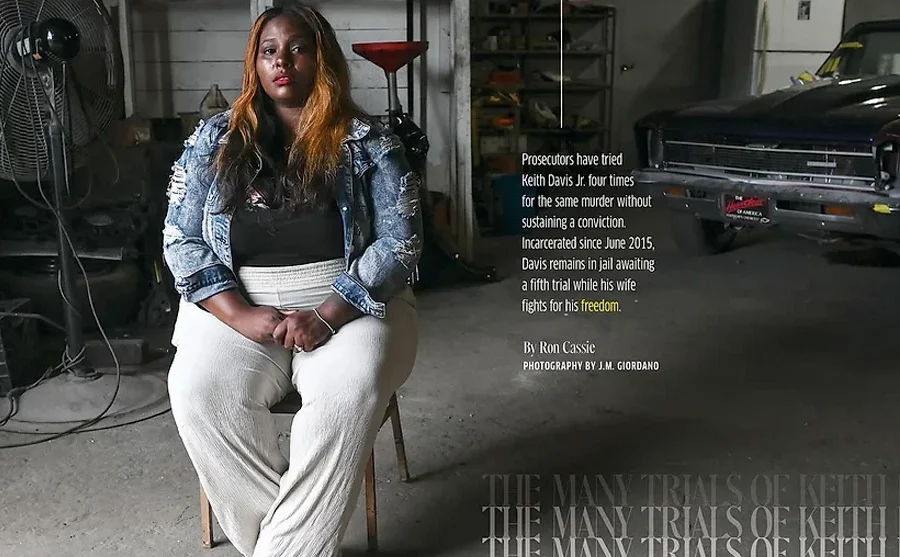
The Many Trials of Keith Davis Jr.
“BABE, I’MA DIE!
BABE, I’MA DIE!
. . . BABE, I’M GONNA DIE!”
POP, POP, POP
POP, POP, POP
Incoming call Sunday, June 7, 2015, 9:57 AM 1 mins 6 secsPanicked, she dialed her stepmother at her home in Park Heights. Keith had spent the night with Kelly’s brother, a longtime friend of Davis’ who was living there at the time. Her brother told Kelly that Keith must be “playing.” She knew different. Kelly’s stepmother had assumed Keith, with the weekend off from work, was still asleep downstairs, but she understood the terror in Kelly’s voice. Unsure who to reach out to, Kelly called her daughter’s godfather, a Northeastern District detective. He quickly pieced together that Keith had been in a “police-involved” shooting a mile away, and suggested she call local hospitals. By noon, Kelly was at Sinai Hospital trying to find out if her boyfriend was alive. She was told he was in critical condition following intense surgery. She was also told she couldn’t see him and police were in his room. Why, Kelly had no idea. “Then I walked into the waiting room and looked at the TV, and saw [BPD Deputy Commissioner] Jerry Rodriguez on WJZ, on the 12-clock news,” Kelly recalls. “He was saying police had shot a man earlier that morning who had robbed a hack driver and shot at police officers during a standoff.” A Sinai admissions staffer gestured toward the television and told her the man they were talking about was her boyfriend. Six days later, Keith Davis Jr. was charged with armed robbery and multiple counts of firing a weapon at law enforcement officers. “None of it made any sense. I’d woken up into a nightmare.”
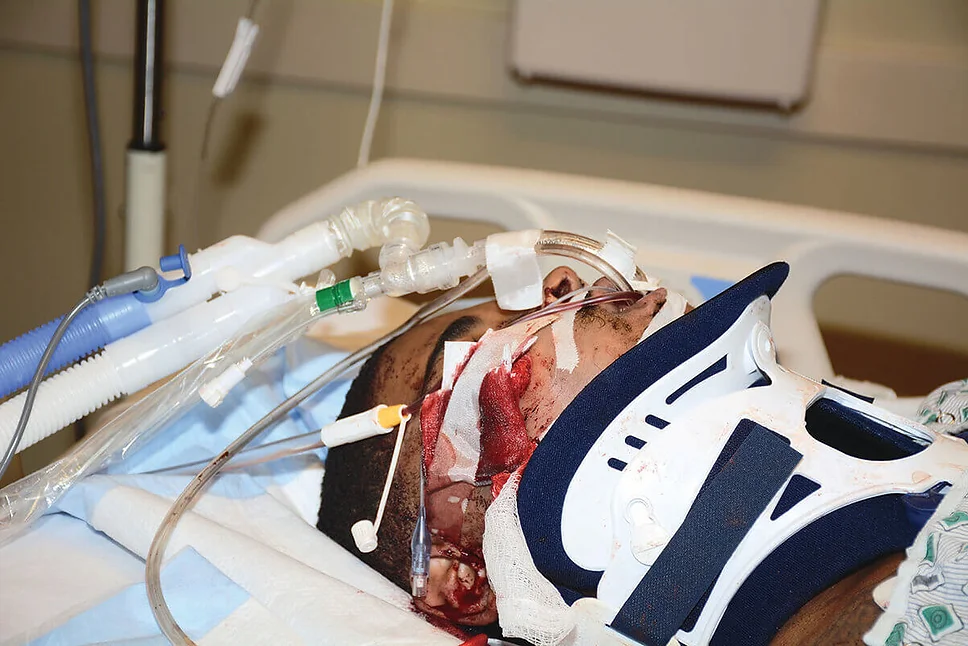
ABOVE: KEITH DAVIS JR. IN THE HOSPITAL AFTER THE SHOOTING. BELOW: KEITH DAVIS JR. IN THE HOSPITAL AFTER THE SHOOTING. OPENING PHOTO: KELLY DAVIS VISITS THE GARAGE FOR THE FIRST TIME WHERE POLICE FIRED MORE THAN 30 ROUNDS—MANY BULLET HOLES ARE STILL VISIBLE—AT HER HUSBAND
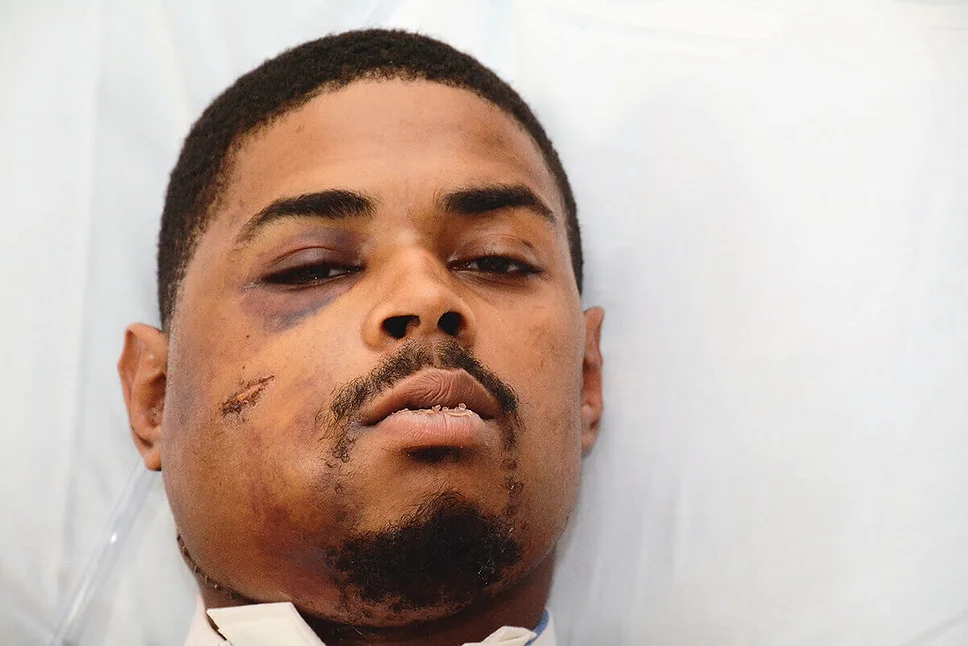
IN JANUARY 2016, seven months after surviving that barrage of police gunfire inside Big Herb’s Auto Repair, Keith Davis Jr. was found not guilty of the armed robbery when the driver repeated what he’d said all along: The cops chased and shot the wrong guy. Davis, who’d just bought a pack of cigarettes from a convenience store, had run, with others, when someone yelled, “Gun!”—dashing across Reisterstown Road into Big Herb’s alley garage. Shortly before going to court, prosecutors had dropped the most serious charges, the counts of firing a weapon at police. Kelly thought her nightmare was coming to a close.
Instead, days after Davis’ acquittal, the City State’s Attorney’s Office—without a hint to Davis, his family, Kelly, or his defense attorney since his shooting by police—indicted him for murder in the seemingly unrelated slaying of a Pimlico security guard. Five hours before the hack driver had been robbed, Kevin Jones had been brutally shot 11 times, including in his mouth and head, while walking to work across the racetrack’s parking lot.
To date, the State’s Attorney’s Office has failed four times to convict Davis of the same murder. Incarcerated ever since he was moved from Sinai to Central Booking with shrapnel still in his neck, Davis now awaits a fifth murder trial set for May. That prosecutors dropped the charge of shooting at police, lost the armed robbery case, and now are 0-for-4 on the homicide charge, is not surprising. In 2018, the Civilian Review Board recommended suspending two officers and terminating two others involved in the Davis shooting for their excessive use of force, and the “serious discrepancies” and “lack of credibility” in their testimony. One of the first two officers on the scene, Catherine Filippou, later resigned when it was revealed the FBI was investigating her alleged involvement in a drug trafficking ring.
To say there have been other red flags in the five Davis trials is an understatement. To name a few: the state’s introduction of a professional jailhouse informant, a discredited drug cartel enforcer, at the second murder trial; the state’s “accidental” disclosure of surveillance video during the third murder trial; and the strange actions and contradictory testimony of not just the police at the scene, but lead detective Mark Veney, who inexplicably did not turn victim Kevin Jones’ two cellphones over to evidence collection for 11 months. Veney’s testimony has been so shaky throughout the trials, including the invention of a fictitious BPD investigator, that he was not called to the stand by prosecutors at the most recent trial, but by the defense.
Then there are the elephants in the courtroom. Prosecutors don’t have evidence Keith Davis Jr. and Kevin Jones knew each other. They don’t have DNA linking the men. They don’t have a motive.
Only one other person in U.S. history has been tried six times in total around the same incident, according to research by University of South Carolina law professor Colin Miller. Following a U.S. Supreme Court decision overturning his last conviction, Curtis Flowers was freed two years ago from a Mississippi jail after 22 years behind bars. Flowers filed suit this fall against the prosecutor in his case.
There’s a kicker, too. This summer, after a conviction in his fourth murder trial was overturned and Davis was due to be released, the State’s Attorney’s Office added a fresh charge of attempted first-degree murder for a prison fistfight a year earlier. In the surveillance video outside the cell where the brief fight took place, both Davis, a slight 152 pounds, and the man he fought, who did require stitches, walked away from that brawl unassisted. No weapon was recovered, according to charging documents.
“Keith Davis Jr.,” says Miller, who co-hosts the podcast Undisclosed, which investigates wrongful convictions and highlighted Davis’ case in 2019, “is the most aggressively prosecuted man in American history.”
JANUARY 2016 Armed Robbery Trial *ACQUITTED
MAY 2017 Murder Trial I *MISTRIAL
OCTOBER 2018 Murder Trial II *OVERTURNED
OCTOBER 2018 Murder Trial III *MISTRIAL
FEBRUARY 2020 Murder Trial IV *OVERTURNED
MAY 2022 Murder Trial V
PROSECUTORS DON’T HAVE EVIDENCE KEITH DAVIS JR. AND KEVIN JONES KNEW EACH OTHER. THEY DON’T HAVE DNA LINKING THE MEN. THEY DON’T HAVE A MOTIVE.TO SMITH’S POINT, the armed robbery of Holden was not seriously investigated. His car was never impounded and checked for fingerprints or DNA. No statements are on record from eyewitnesses of the foot chase off the busy West Belvedere Avenue. As far as the shooting barrage inside the garage, FIT investigators made no effort to resolve numerous discrepancies in the accounts of the responding officers. At one point, three different officers said they were the one who’d handcuffed Davis as he lay in a pool of his own blood. It’s also not clear how the gun police say Davis was brandishing, and his wallet, got so neatly placed next to each other atop the refrigerator. Eskins said Davis placed the gun on the stand-up refrigerator after getting shot in the face and surrendering. Filippou said she never touched Davis’ wallet, but when she called for dispatch she gave them Davis’ drivers license number. Dispatch also wasn’t told there was a shooting victim at the scene. Because there is always more: The arriving paramedic testified he didn’t see a gun anywhere. It’s worth keeping in mind, the FIT unit that investigated Freddie Gray’s deadly arrest, which the State’s Attorney Office partly blamed for having to drop the charges against all six officers, also investigated the shooting of Keith Davis Jr. For all intents and purposes, FIT investigators ignored the damning viral video of Gray’s arrest and the numerous eyewitness accounts of the shackling of Gray’s hands and feet at the second stop, where the limp, no doubt already severely injured 25-year-old was heaved back in the transport van. Similarly, in the Davis case, the Force Investigation Team, which did not include a single homicide detective and was disbanded soon after the Davis incident, ignored critical witness accounts. Instead, BPD investigators (and the medical examiner in Gray’s case)—and prosecutors—relied on the version of events put forth by police involved who potentially faced criminal charges.
“Not only did the state never try to resolve the various versions from police officers, who contradicted themselves and each other at every turn, they never were searching for truth,” says lawyer Latoya Francis-Williamswho represented Davis at his armed robbery acquittal, first murder trial, in which 11 of 12 jurors voted to acquit, second murder trial, and now serves as his civil attorney. “One thing you have to keep in mind, when the state charges someone with murder, people are inclined to believe the person did something wrong. Why else would the state go to court? And when the state takes as many bites of the apple as they’ve done with Keith Davis Jr.? People want to believe there must be good cause. That is an onerous mountain to climb each time.” Though the contexts are different in the Gray and Davis cases, flipping the politics for State’s Attorney Mosby, the bottom line is the same. No officer has been held accountable. Meanwhile, Kelly Davis, along with Tawanda Jones, whose unarmed brother Tyrone West was killed by police in 2013, has become the public face of police and prosecutor accountability in the city. A paraprofessional educator and a mother of four school-age children from a previous marriage, she’d been taking her relationship with Davis slowly before the shooting. He is six years younger. But she was impressed by the everyday way he took care of himself, putting money in the bank, keeping his health insurance up to date, and taking an interest in her children—things like buying them ice cream. When he told her about his drug conviction, those qualities overrode her concerns. That they had an instant connection is undeniable, and she has come to admire the strength of his character since he’s been incarcerated, adding that, with their near-daily phone calls, they’ve been able to pick each other up through their ongoing ordeal. In 2017, they married at the Jessup Correctional Institution. Davis has had several surgeries related to his shooting injuries (he also contracted COVID-19), which made marriage more urgent in order for Kelly to advocate on his behalf. At the time of his arrest, she had not followed politics or criminal justice issues closely, which embarrasses her a bit now, she admits. “Freddie Gray was just water cooler discussion,” she says. She was certain, however, when State’s Attorney Mosby learned the details of Keith’s case, he’d be returned home. “I thought she was going to be the savior.” She and her husband’s supporters are collectively known as “Team Keith.” Most, if not all, of the activists enthusiastically supported Mosby in her upset over former State’s Attorney Gregg Bernstein in 2014. Now they find themselves on opposite sides. They made Davis’ cause an issue in Marilyn Mosby’s reelection three years ago and will do so again next year unless the murder charges are dropped. Over the past six years, working with Tawanda Jones, the grassroots group Baltimore Bloc, and others, Davis has organized countless demonstrations at the courthouse, City Hall, and town hall meetings Mosby attends. She addressed the massive march after George Floyd’s death that shut down I-83. She hired a billboard truck this summer to drive around the city with information on her husband’s case. She’s organized canvassers to hand out flyers with information and the State’s Attorney’s number, asking people to call and demand Mosby drop the case. “I needed to get people behind me and go public, but I didn’t know how,” she says. “So I went to a meeting. I met [activist] Kwame Rose. He gave Tawanda’s number. Then, people from Bloc reached out and started coming to court with me. I wasn’t getting anywhere by myself and you need to make noise in Baltimore, or people move on. I want the whole world to know Keith’s name.” While elected officials all certainly know his name, Mayor Brandon Scott, who didn’t respond to interview requests, and the City Council, have been deafeningly silent. A lot of that has to do with State’s Attorney Mosby’s “progressive prosecutor” branding and the combination of power wielded by her and Council President Nick Mosby, her husband, who have a deep political base and high-profile local and national supporters. (The power couple is also under federal investigation related to their taxes, which is the other issue no one at City Hall will discuss with the media. Leaders of the Baltimore and Maryland chapters of the NAACP, the Rev. Jamal Bryant, and attorney Ben Crump recently attended a press conference at Douglass Memorial Community Church in support of Marilyn Mosby in light of the FBI tax fraud investigation.) The exception is Councilman Ryan Dorsey, who attended the third murder trial and stated flatly in a recent interview, “Keith Davis is innocent, should not be incarcerated, and should not be tried again. End of story.” Dorsey, like state Sen. Carter, adds the case is emblematic of police violence, the lack of prosecutorial oversight, and “failure of our mass incarceration state.” Kelly Davis and her husband have growing national support, too. Campaign Zero, cofounded by Baltimore-born and -raised activist DeRay Mckesson, got involved this summer, launching an interactive website with links to court transcripts that highlight, according to Mckesson’s count, more than 200 contradictions, problems, falsehoods, and errors over Davis’ five trials. “The truth is actually just so clear that we don’t need to embellish it,” Mckesson told reporters in the law offices of the couple’s civil attorney. “I don’t need to do anything to it. I just need to show you.” For her part, State’s Attorney Mosby, who declined an interview, has said that in the past that her job “is to ensure justice for Kevin Jones. It’s not about Keith Davis for me. It’s about Kevin Jones. That was the victim of the homicide.” Nonetheless, it has turned personal. At a casual May staff outing at the outdoor bar Sandlot at Harbor Point, Mosby was captured on cellphone video giving the middle finger to a bicyclist who rode past her and several colleagues while twice shouting, “Free Keith Davis Jr.!” Mosby initially denied making the gesture, but then admitted she had done so when stills from the video proved she wasn’t telling the truth. “Why does she keep trying to convict this man after failing so many times when she dropped all the charges against the officers in Freddie Gray’s death?” Tawanda Jones asks during a recent protest at a Park Heights rec center, just blocks from the murder of the Pimlico security guard and Davis’ shooting. “She knows the police were guilty of using excessive force and their statements and testimony all contradicted each other. She’s protecting the police and, she thinks, herself. But we know [the police] plant drugs and guns. That’s been established.” Jones is referencing not just the Hawkins’ case, but the damning information that came to light related to the infamous Gun Trace Task Force. As part of that years-long investigation, Detective Maurice Ward testified he and his partners were coached to carry BB guns and replicas “in case we accidentally hit somebody or got into a shootout, so we could plant them.” Another Baltimore detective caught up in the sprawling scandal, Marcus Taylor, had a replica gun very similar to his department-issued firearm in his possession when he was arrested last year. Last year, Det. Robert Hankard was indicted on federal charges related to allegations he provided a BB gun he knew would be planted on a suspect. Also in 2020, the city settled with William James and Ivan Potts, admitting the guns that led to their wrongful convictions were planted by Baltimore police. In Potts’ case, police had attempted to shove a gun in his hand to get his fingerprints on the firearm and then beat him so badly he had to be driven to an emergency room before he could be booked and charged. Just before this story went to print, the city approved a $230,000 settlement with Richard Gibbs, after a jury basically agreed police planted a gun on him after he was shot in the chest during a routine traffic stop.
“LET ME PUT IT THIS WAY, I DON’T THINK THERE IS ANYONE OUTSIDE THE CITY STATE’S ATTORNEY’S OFFICE THAT BELIEVES THE PROSECUTION OF KEITH DAVIS JR. SHOULD CONTINUE.”ALL THAT SAID, the crux of the state’s murder case against Keith Davis Jr. comes down to four things. 1) The test-fire markings from the gun police say they recovered near Davis, according to BPD experts, match the shell casings from Pimlico. 2) The partial palm print found on the gun after police turned it in. 3) The cell tower pings that put Davis in the general radius near Pimlico when Jones was killed. 4) Prosecutors say, following the mysterious appearance of sidewalk surveillance video at the third murder trial, that a mask-wearing man walking behind Jones moments before he’s shot to death—is Davis. On closer inspection, the underlying facts behind each point are less than rock-solid. First, it’s necessary to recall the testimony of the department’s ballistics examiner at the armed robbery trial. He testified he found no traces of gun residue on the Hämmerli Trailside pistol police say they found atop the refrigerator and testified it hadn’t been fired that day. It suggests Davis would’ve had to have had access to a utility brush, swab, rod and bore cleaner, and lubricant, and known how to clean a gun, and done so somewhere in the time between Jones’ murder and the shooting in the garage. More generally, ballistics evidence has come under significant scrutiny in recent years. Detroit’s ballistics unit was shut down when auditing revealed a 10 percent error rate. Regarding the fingerprint evidence, which is not the DNA equivalent many people believe, BPD’s analyst testified she left her office, went to evidence control to retrieve the gun, returned to her office, and conducted an elaborate process that manually traces the fingerprint in loops, in a mere six minutes, according to logs. At trial, she testified she kept no notes, a common best practice. This, however, is also not a surprise. While violent cases are prioritized, in August the head of BPD’s crime lab came out publicly and acknowledged a backlog of 11,000 fingerprints. In terms of cell tower pings, which don’t pin locations like the GPS on your phone does, those are not really in dispute, only the way they’re presented. Davis lived in Columbia, Maryland, at the time, and his alibi, confirmed by others, is he was staying several blocks from Pimlico at Kelly’s stepmother’s home after a neighborhood cookout the evening before Jones’ killing. In fact, Kelly also kept a screenshot of a 90-minute call they had that morning, her to him, which began, at most, five or six minutes after Jones was shot 11 times, in what appears a targeted execution.
Outgoing call Sunday, June 7, 2015, 4:56 AM 90 mins 23 secs“Keith would have to be a sociopath to go on some random killing and crime spree, shooting someone he doesn’t know 11 times, then talking on the phone with me, completely normally for 90 minutes, then what, going out again to rob a hack with the same gun?” says Kelly, of the late night/early morning call. “He didn’t want to mess up because he was due to come off parole soon. Keith and I hadn’t seen each other the day before. So we’re texting and talking all night back and forth, making plans to see each other because Keith has work on Monday and so do I.” Davis had been employed for the past six months at a food preparation business in Halethorpe, a job he liked, and where he could earn overtime when he needed extra money. He had a weekend side hustle, too, helping a local moving company under the table. As far as the footage across the street from Pimlico, it appears to show a man thicker-built than Davis, wearing a different T-shirt than the one he’s wearing five hours later when he’s shot by police. Prosecutors claim the jeans and sneakers of the suspect in the video resemble those of Davis, but none of Jones’ blood or DNA was found anywhere on Davis’ clothes or possessions or vice versa. Mostly, however, the blurry images preclude identification, one way or another. When Veney was on the stand, he said he’d looked at the tape previously, did not reveal the nature of its contents to anyone, and dismissed it as having “no evidentiary value.” Given that it shows Jones in his Pimlico uniform, a man pulling a mask on behind him, and a possible witness walking his dog—it is an incredible statement. “First, there is the fact that Detective Veney said he asked the CCTV street footage be pulled [from closed-circuit police cameras at the Pimlico intersection] and was told the cameras were pointed at the trees,” says attorney Natalie Finegar, who represented Davis at his third murder trial. “I tried to subpoena that video, but because he made no actual formal request to see the footage, it was deleted. As far as the store surveillance video, either he never watched it and said he did—or he saw it and kept its contents to himself. But in the middle of the third trial, it is suddenly found and introduced, and state goes from claiming it shows nothing of value to [saying] the suspect in the video is my client? I’ve been doing this for 25 years. I have never seen anything like that.” Then, there’s the lone eyewitness to the killing, whose account Veney also dismisses. Fellow Pimlico security guard Vaughn Ringgold told Veney he was walking to work like Jones and interacting with him just before Jones ducked through a popular cut-through in the gate outside Pimlico’s expansive parking lot where he was shot. Ringgold told Veney and his partner the killer “looked like he was in his about 30s or 40s” and indicated he appeared bulkier than the 23-year-old Davis. “I would say he probably—probably works out.” One more revelation about the murder investigation, or lack thereof: Another co-worker of Jones’ provided a lead on a potential motive for the killing. But not only did Veney and detectives not follow-up with Donald Long, it is believed by Davis’ defense team they withheld that possible exculpatory motive theory. Long signed an affadavit in 2019 saying that Jones had told him he “dabbled in buying and selling drugs” and that he wanted to get out of dealing because he’d been shot in the leg previously, and two weeks prior to his murder, he had witnessed his cousin’s murder. Long wrote in his sworn statement that he believed Jones was targeted after witnessing his cousin’s murder. In fact, as McDonell-Parry, who has since become an investigator in the public defender’s office, learned during her reporting, several associates of Jones were killed in the weeks before and after his murder. Former commissioner Kevin Davis, who led the BPD from July 2015 to January 2018 and is now the Fairfax County police chief, would not discuss police-involved shootings or FIT unit investigations during his tenure. IN A BRIEF, time-constrained phone interview from prison, the soft-spoken Davis admitted it has been a difficult half-dozen years locked up, physically and emotionally, away from Kelly, her kids, and his family. The missed birthdays, anniversaries, and holidays remain especially hard. By his wife’s count, he has been moved more than 12 times from institution to institution, which makes maintaining those bonds even more challenging. “It has been kind of up and down, but I try to stay as positive as possible,” Davis says, adding he still suffers from breathing issues, particularly when he first wakes up, from sinus problems caused by the shooting. On the advice of his legal counsel, he won’t discuss the current pending cases, but adds that he is aware of the advocacy for his cause from the vocal band of “Team Keith” activists. “It’s a blessing,” he says. In October, Kelly Davis stepped inside Big Herb’s Auto Repair for the first time. Big Herb has since passed, but his oldest son, also Herbert Berkley, was inside doing work on a car on the garage’s lift. The 5200 block of Eleanora Avenue is more alley than street in this disjointed section directly behind Reisterstown Road. Keith’s stepfather used to help run the family bail bonds business a half-block up Reisterstown Road, which is why Keith had come this way the morning the hell began. He’d walked the mile from Kelly’s stepmother’s house, accompanying an uncle who cleaned a nearby restaurant and bar on weekends. Davis hung around, planning to check in on his stepfather, whom he expected would open the office a few doors down around 10 a.m. For years as a kid, Davis’ stepfather, Tony, had picked Davis and his sister up after school and brought them back to work until it was time to go home for dinner. The Northwest District police station sits 150 yards away on the same side of the block. At the first trial, Keith Davis Jr. testified he’d just lit a cigarette in the 5200 block of Reisterstown Road when someone yelled, “Gun!” As Eskins came running down the alley next to the food mart, he took off. The alley street in front of Big Herb’s is narrow, but it is usually a beehive of activity. There’s a couple other small tire and repair shops. On a recent Saturday afternoon, at the repair shop closest to Herb’s place, a handful of guys with Caribbean accents are turning wrenches and sipping bottles of beer. Kids race bicycles and dirt bikes up and down the alley because theoretically, without speeding traffic, it’s safe. Around the corner, there’s a commercial BBQ grill cooking chicken and ribs on another convenience store’s sprawling lot, doing a brisk business. Further down, Jack Paulsen Park is packed with families for weekend youth football games. Later, in the afternoon, high-stepping West Baltimore marching bands parade down Park Heights Avenue just below Pimlico. Park Heights, which is also where Mayor Scott grew up, is a complicated place. The block of rowhomes where Kelly’s stepmother lived have been knocked down. Over on West Belvedere Avenue, exactly where Charles Holden was robbed at gunpoint in his own car, young guys are busy on the corners selling drugs, practically stopping traffic to do so. Two other adults on the street are pointing at the ground, the ubiquitous Baltimore signal to hacks that they need a lift. As Kelly steps from the bright sunlight into the open garage, Berkley, a large man like his father, takes a stride forward to greet her. He’s been expecting her. It’s quiet for the moment outside. “Hi, I’m Kelly,” she says, extending her hand. “My husband was shot in here.” “I’m sorry,” Berkley says softly, stepping back and telling her it’s okay to look around. To take her time. The shop is larger than the average two-car suburban garage, but not a lot. She notices a white refrigerator against one wall and asks Berkley if it’s the same refrigerator that had been there on the day of shooting. “It’s not,” he says. “The old one used to be over there,” he adds, gesturing toward a steel beam in the middle of the garage floor. She looks and then turns back, suddenly noticing the first few of maybe two-dozen bullet holes that are still visible in the bathroom and office walls, and the pockmarked concrete wall in the rear. She notices another hole in a metal tool chest, and begins to choke up and wipe away tears. Read Original Story in the Baltimore Magazine